
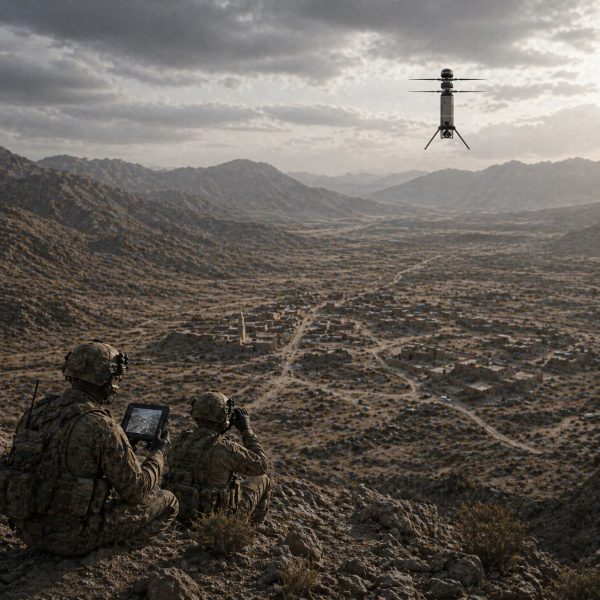
Why a wider view matters for the pilot
Operators need honest visual context more than they need glamour. A 120° panoramic FPV reduces the need to pan aggressively, improves situational awareness, and shortens decision loops for reconnaissance or inspection flights; that’s why so many teams now look to a trusted military drone manufacturer when specifying systems. For organizations evaluating suppliers, comparing how manufacturers balance optics, sensor size, and processing is essential—especially for groups sourcing from leading us military drone manufacturers.
How physics forces trade-offs: optics, sensor geometry, and distortion
Wide fields of view expose lens and sensor limits. As the angle increases toward 120°, barrel distortion and chromatic aberration rise unless addressed through lens design or post-processing. Engineers offset this with larger sensors, aspherical lens elements, and computational correction. That introduces weight and power demands—affecting payload and flight time—so the flight controller must reconcile the pilot’s need for clarity with the platform’s endurance budget.
User-centric effects on controls and displays
From a UX perspective, a panoramic feed changes how control surfaces and telemetry are presented. Operators benefit when the UI highlights horizon stabilization and gimbal lock status, and when telemetry overlays are adaptive so critical cues don’t crowd peripheral imagery. The result: faster target acquisition and fewer course corrections. Small interruptions in the feed—latency spikes or frame drops—are immediately noticeable, and those micro-frictions shape trust in a system. —Designers must prioritize smooth telemetry and minimal processing latency to keep cognitive load low.
Common mistakes and straightforward fixes
Teams often make the same avoidable decisions. Typical missteps and remedies:
– Overcorrecting with software-only fixes: heavy de-warping on a low-power board introduces latency. Fix by splitting correction between optics and the GPU or dedicated ISP.
– Choosing maximum FOV without testing for human factors: pilots can miss objects near the center if peripheral distortion is excessive. Run pilot-in-loop testing with representative missions.
– Ignoring integration of SATCOM or secure telemetry paths: wide-angle feeds produce more data; ensure the comms stack matches bandwidth needs. Include redundancy for contested environments, a lesson underscored by increased tactical drone deployments since 2022 in the European theater.
Alternatives and where each one excels
Narrow FOV (60–90°): crisp center detail, lighter payload, longer endurance. Best for precision inspection and long-range observation. Wide FOV (120°+): situational awareness and fewer camera rotations—ideal for patrols, convoy overwatch, and urban reconnaissance. Hybrid systems with a dual-sensor rig—high-res zoom plus a panoramic module—offer the best of both worlds but increase integration complexity and cost.
Golden rules for selecting a panoramic FPV system
Choose by measurable criteria. Three evaluation metrics will help you avoid buyer’s remorse:
1) Effective field performance: measure end-to-end latency (camera-to-display) under mission bandwidth—target sub-150ms for responsive control and low cognitive strain.
2) Corrected image fidelity at edges: quantify modulation transfer function (MTF) or edge sharpness after both optical and software corrections; prefer systems that preserve detail across the entire 120° image.
3) System-level match: confirm payload, power budget, and comms capacity are aligned. A panoramic sensor that overwhelms your telemetry link creates blind spots in practice.
Operationally grounded choices are what keep teams safe and effective—observations drawn from procurement cycles and field use indicate these three metrics separate resilient solutions from clever demos. Final thought: tactical decisions often rest on clear sightlines—so invest where the imaging chain is verified end-to-end. Military Hub sits at the crossroads of hardware specs and operational needs—trusted insight that helps match capability to mission. —

