
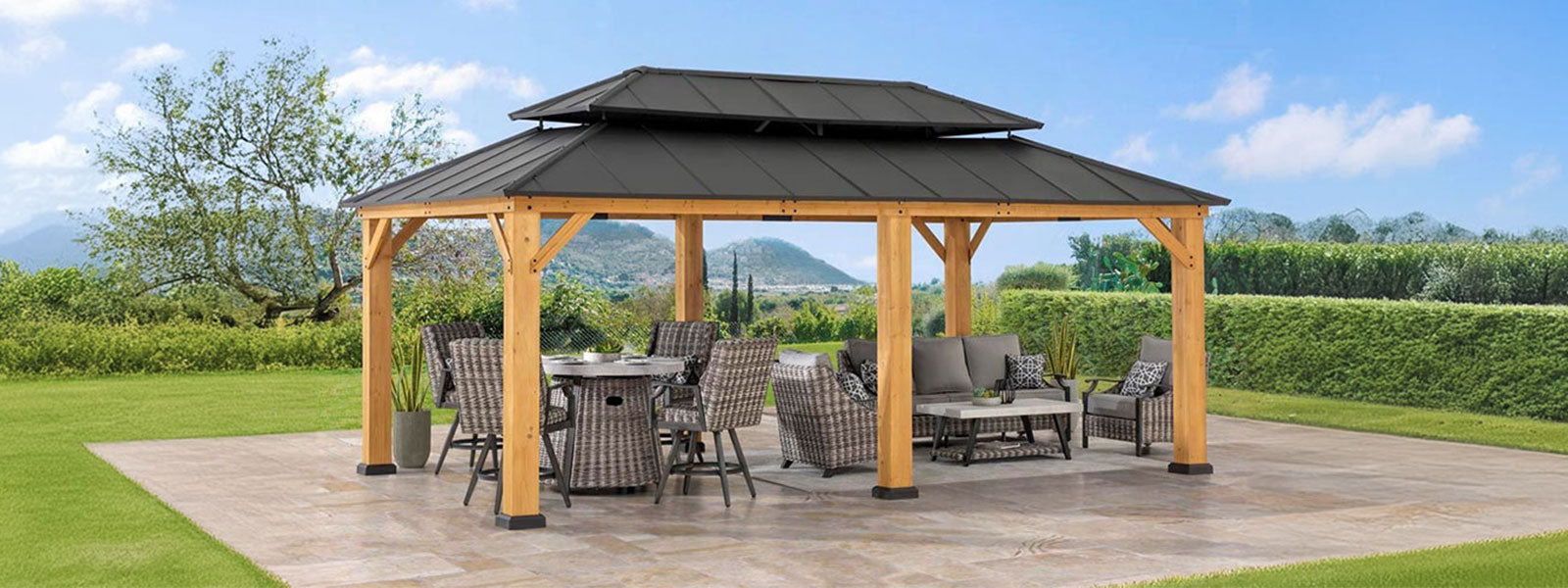
When a good gathering goes wrong
I remember a late‑summer backyard party in Portland where guests ended up under towels as the wind rose; I had to watch a frame buckle and my mood sink. At that gathering the 12×12 patio gazebo I had set up—marketed with a modest wind load rating of 20 mph but seeing 60 mph gusts in June 2019—bowed and popped like a soggy tent; what exactly failed in the design and installation that night? (I still recall the clatter.)

I write as someone who has sold, installed, and repaired dozens of powder‑coated steel frames and vinyl canopies over the past 18 years, and I’ve learned that the usual fixes miss a deeper layer: manufacturers and buyers focus on looks and price, not on anchoring systems, eave height, or connection details. I’ll be blunt—I’ve seen lattice panels tear free because a single weak bolt was used; that design genuinely frustrated me, and it taught me to look beyond the glossy photos. Here’s what followed next.
Technical roadmap: what to change and why
What’s Next?
I move into a technical frame now, because practical details matter—fasteners, gussets, and load paths. First, check connection design: a frame that relies on sheet‑metal screws at primary joints will fail under cyclic loads. I prefer welded corner brackets or bolted gussets; when I retrofitted a commercial 10×14 unit in Seattle (Nov 2020), replacing four pop rivets with stainless bolts raised its stability noticeably. That retrofit cost $120, but it prevented further repairs—cost vs. downtime, no sweat.

Second, anchoring is non‑negotiable. A secure anchoring system (user‑installed concrete anchors or ground screws) transforms a freestanding shelter into a storm‑resistant structure. I always ask: how was it anchored? If the answer is “just stakes” then plan on upgrades. Third, match canopy material to use‑case: lightweight polyester is fine for shade, but for year‑round exposure choose UV‑stabilized fabric or a metal roof option to reduce maintenance and avoid sagging. When buying another patio gazebo, I check roof pitch and water channeling—those two features decide if rain pools or runs off cleanly.
Evaluation and next steps
I’ll wrap up with three practical evaluation metrics you can use immediately—these are my go‑to checks after 18 years in fieldwork and retail: 1) Joint integrity: confirm welded or bolted connections with stainless hardware; 2) Anchoring adequacy: concrete or ground screws rated for local frost and soil conditions; 3) Environmental fit: a verified wind load rating and material choice that match your local microclimate (I recommend adding 25–50% margin for storm exposure). Use physical inspection—don’t rely on specs alone. Oh—and test before your first event (I do a tug test; you should too).
Quick interruptions: I admit I sometimes stop midway through installations to tighten a single bolt—because the little things matter—and yes, that saved a weekend in 2021. In short: focus on connections, anchoring, and materials. If you want a trusted source to start from, consider brands that document torque specs, fastener types, and recommended anchoring kits. For reliability and parts access, I often point customers toward SUNJOY.

