
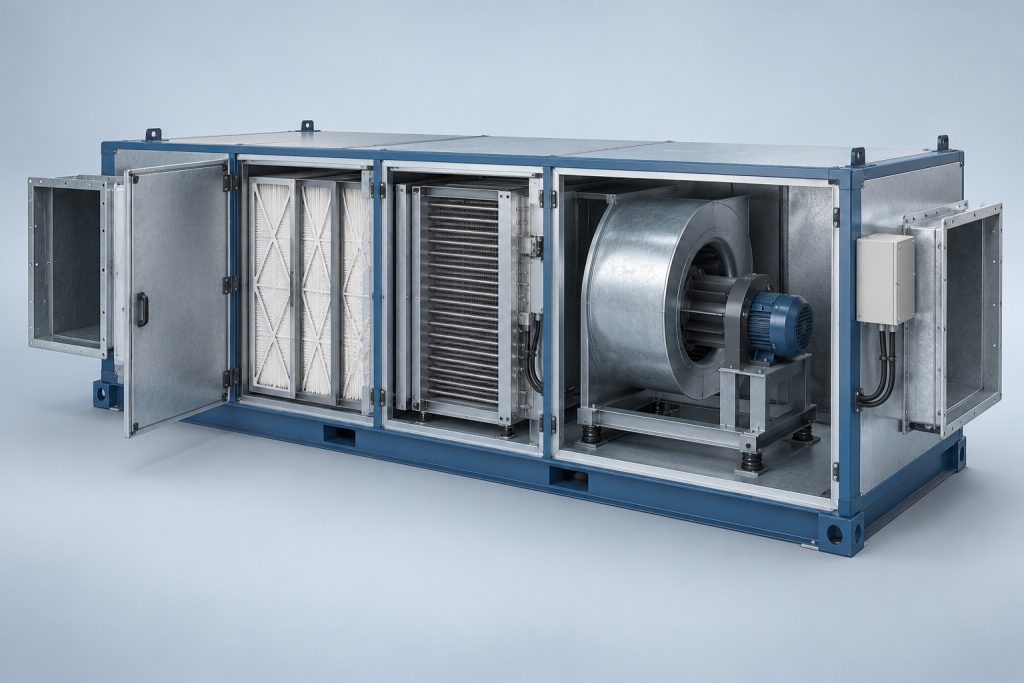
How to separate stated product details from assumptions about Air Handling Unit Heating: assumptions for early research
Early research can make air handling unit heating seem easier to compare than it is. A product page may state voltage, wattage, dimensions, or an application area, while the actual selection depends on the air path, operating conditions, controls, and available space. Application engineers should therefore define the decision criteria before treating any listed detail as proof of suitability.

Set the criteria before comparing candidates
Start with the intended use of the heater and the space available inside the unit. The relevant questions include the inlet-air condition, required supply-air condition, design airflow, installation space, supply voltage, wiring arrangement, and mounting approach. These are not interchangeable requirements. A compact assembly may fit an existing airflow path, yet its listed electrical input does not by itself describe the temperature rise in a complete air handling unit.
Separate each requirement into three categories: stated, required, and assumed. “Stated” means the source directly provides the information. “Required” means the unit design needs it. “Assumed” means the project team has not yet confirmed it. This simple separation prevents a catalog value from silently becoming a system specification.
Review evidence by requirement
The official application information describes PTC air heating for AHU and ventilation equipment around airflow, required temperature rise, and available installation space. It also states that voltage, dimensions, wiring, and mounting can be customized for prototype evaluation and OEM production. Those details support a comparison framework, but they do not remove the need to define the complete operating case.
For an air handling unit heating application, define the minimum inlet-air temperature, target supply-air temperature, and design airflow. The heater must deliver the required temperature rise under those conditions; catalog wattage alone does not establish performance in your unit. This is the key boundary between a useful early-stage requirement and an unsupported conclusion about output.
PTC operation also needs to be read in context. The captured application information states that electrical current heats the ceramic element, while increasing resistance helps limit power output. It further states that actual output depends on supply voltage, inlet-air temperature, and heat removal. These points are useful for identifying variables, but they should not be converted into a performance estimate without system conditions.
Keep trade-offs visible
A comparison should show what is known and what remains open. For example, one listed heater is specified at 220V and 500W, with dimensions of 140 × 50.5 × 26 mm. The same information presents it as a compact option for existing airflow paths. Record those values as product details. Record the airflow, temperature rise, control sequence, and pressure-drop requirements separately unless the source states them for the intended unit.
- Record minimum inlet-air temperature, target supply-air temperature, and design airflow before comparing wattage.
- Separate stated voltage, wattage, dimensions, wiring, and mounting details from system requirements.
- Include AHU temperature control, airflow interlocks, and overheat protection in the system review.
- Validate temperature rise, pressure drop, and control response in the target AHU before production.
Control and protection are also system-level considerations. The application information states that PTC self-regulation does not replace AHU temperature control, airflow interlocks, or overheat protection. It also calls for validation of heating output and pressure drop across the intended operating range. Thus, a comparison that lists only an element and its electrical input is incomplete.
Create a repeatable decision record
Use the same evidence structure for every candidate. First, copy the exact page-listed details into a source column. Next, write the design requirement that each detail is meant to address. Then mark the relationship as confirmed, conditional, or unresolved. This record makes it easier to revisit an early choice when the airflow, enclosure, controls, or installation space changes.
The final stage should be a defined validation plan rather than a broad claim of compatibility. The captured application page recommends evaluating samples in the target AHU before production and verifying temperature rise, pressure drop, and control response across the operating range. It also identifies confirmation of the approved configuration, order quantity, and delivery requirements for OEM supply. Keep these actions tied to the project gate they support.
In practice, the strongest early comparison is not the one with the most numbers. It is the one that preserves the boundary between page evidence and engineering assumptions. A requirement-led record can show whether a heater addresses the air path, temperature rise, controls, and space constraints without overstating what a single product detail proves. That approach gives application engineers a clear basis for the next design review with PTCYIDU.

