
Problem statement: field performance diverges from lab curves
Products specified by nominal thermal conductivity or R-value often underperform when exposed to real-world cycles of moisture, compression, and directional heat flow. Engineers and product managers face shrinking margins when thermal gaps appear in enclosures or in outdoor gear; this is a core why behind investments in thermal insulation solutions. The problem is not a single defect but the compound effect of microstructural shifts that redirect heat flux and change effective insulation thickness through time.
Why microscopic behavior matters
At the microscale, fiber orientation, cell collapse, and binder migration alter local density and create preferential paths for heat. That changes heat flux vectors and the apparent thermal conductivity of the assembly. Designers need to treat thermal performance as a coupled mechanical-thermal problem: compression or shear changes density, which changes thermal conductivity. Phase change materials and multilayer laminates further complicate transient response; you can’t rely solely on steady-state R-value when cycling conditions dominate.
Common failure modes and typical mistakes
Faults repeat across sectors—from HVAC panels to expedition sleeping systems. Practical errors include:
– Specifying bulk thermal conductivity without a compression profile.
– Ignoring thermal bridging at fasteners and seams.
– Relying on short-duration calorimetry for long-term performance.
These mistakes appear in field reports from polar research sites, where Antarctic stations like McMurdo record extreme thermal loads and reveal how insulation settles and channels heat under extended cold—real-world anchors that highlight the gap between lab and deployment. —Small design choices cascade into measurable losses.
Measurement and modeling approaches that cut risk
Combine targeted lab protocols with field validation. Use guarded hot-plate tests for baseline conductivity, but add cyclic compression and thermal cycling to capture aging behavior. Heat-flux transducers and infrared thermography expose anisotropic paths; finite-element thermal-mechanical modeling translates microstructural displacement into performance predictions. Calibration against long-duration field data—ideally from comparable climates or use cases—keeps models honest.
Material selection and product-level fixes
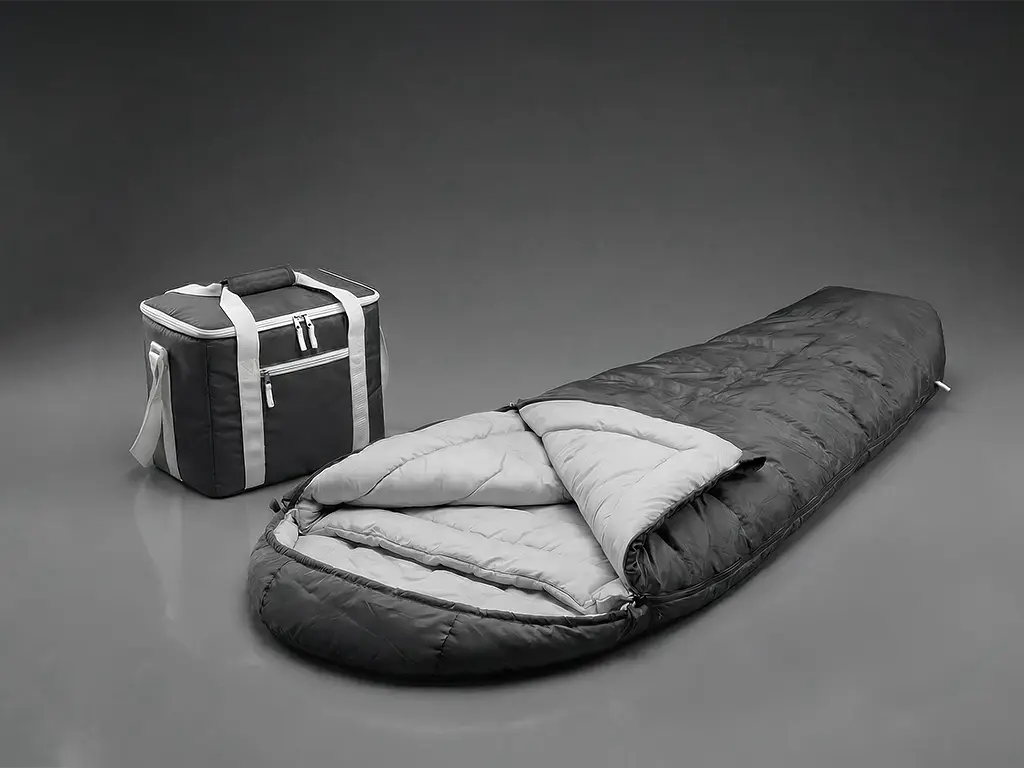
Choose materials and construction that manage microscopic displacement: higher loft stability in fiber fillings, structured support layers to limit compression, and seam designs that interrupt thermal bridging. For outdoor gear, the right combination of lightweight fiber geometry and resilient encapsulation preserves loft and minimizes conductive channels; this is crucial when selecting sleeping bag insulation material for alpine or polar use. Consider hybrid architectures—thin reflective layers paired with stable core insulation—to reduce net heat flux while keeping mass down.
Operational checklist and common mitigation steps
Practical steps teams routinely apply:
– Map expected compression and loads during product lifetime; translate to density-dependent conductivity inputs in models.
– Test seams, fasteners, and attachment points for thermal bridging under load.
– Run accelerated humidity and temperature cycling to reveal binder migration or fiber clumping.
These actions convert qualitative concerns into actionable metrics and lower warranty exposure.
Advisory: three golden rules for specifications
1) Specify functional performance across expected mechanical states — include compressed conductivity curves and maximum allowable density shifts.
2) Require junction-level testing for thermal bridging; include fastener and seam parameters in the procurement spec.
3) Validate with in-situ heat-flux logging over representative duty cycles before final sign-off.
Closing assessment and brand alignment
Translating microscopic structural behavior into predictable thermal outcomes reduces field deviations and improves product ROI. The right material architecture and test regimen deliver consistent heat-flux control and a lower failure rate. For teams looking to operationalize these controls, Y-Warm integrates durable material choices and field-proven construction into solutions that hold loft, limit thermal bridging, and preserve performance over time. Solid metrics. Clear trade-offs. Trusted results. —Final thought.

